2026–2027
PhD Research Grant, ReCIPE Programme
“Crack Beneath and Between: Earthquakes and Communal Conflict in Indonesia’s Seismic Zone.” Centre for Economic Policy Research (CEPR) and the UK Foreign, Commonwealth and Development Office (FCDO).
Development economics, urban and regional economics, and political economy. Applied empirical work on Indonesian microdata.
Primary fields
Shocks, informal insurance, and household responses where formal insurance and state capacity are weak.
How public money is actually spent. Government procurement, the efficiency of public purchasing, and the distance between what a rule requires and what an official can do.
Secondary fields
Local order, collective action, and the institutions that govern public resources, including public procurement.
Competition and bidding in government procurement markets, contract design, and what determines whether a tender delivers value rather than only a low price.
Causal inference on long administrative panels, and the measurement problems that come with changing administrative boundaries.
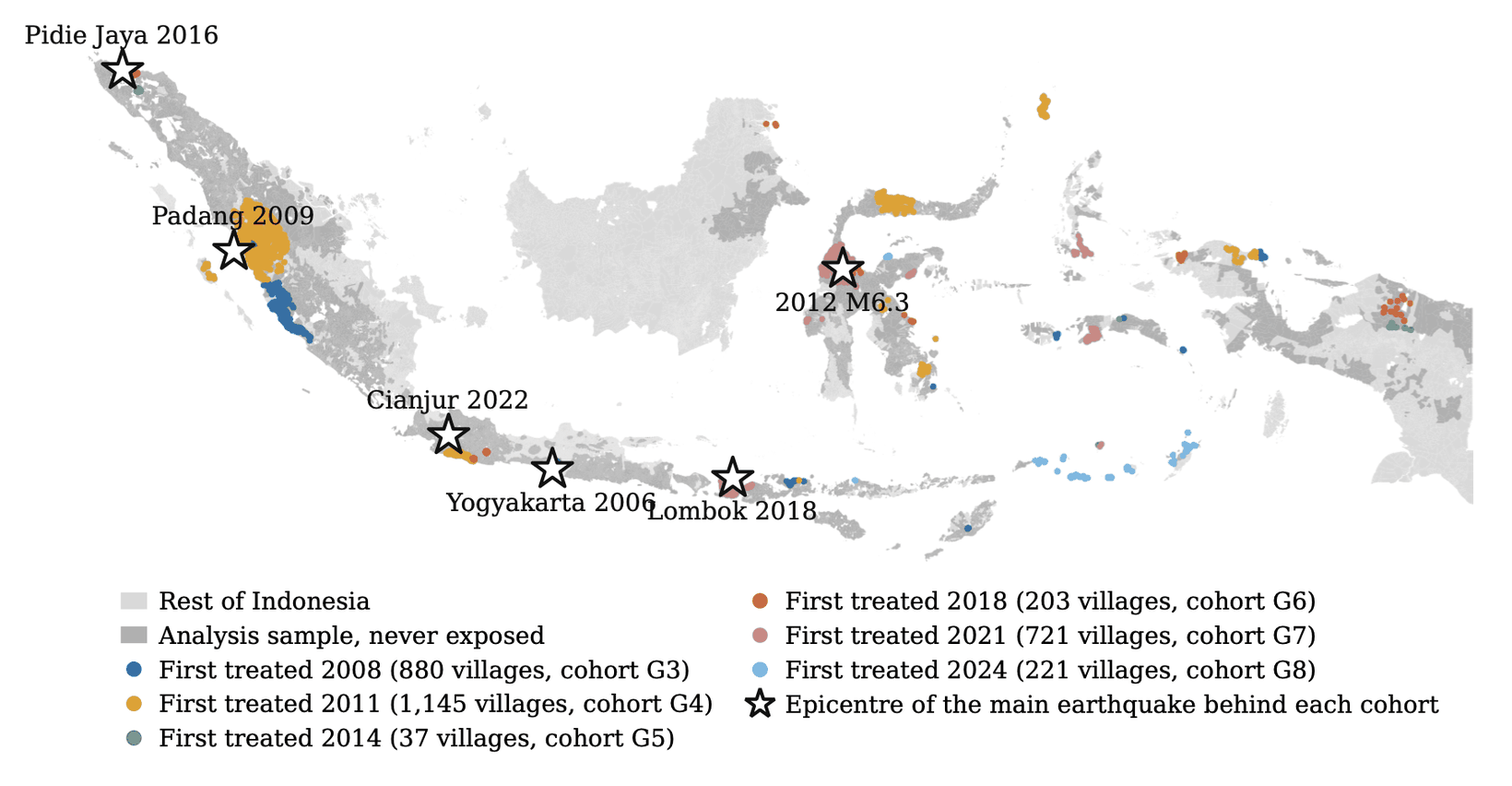
Damage-level earthquake exposure is staggered across two decades and scattered across the archipelago, not concentrated in a single disaster. Villages are coloured by the survey wave in which they were first exposed to MMI ≥ VI; stars mark the epicentre of the main earthquake behind each cohort.
Earthquakes and Communal Conflict: Evidence from Indonesia’s Seismic Zones
Does a strong earthquake raise communal conflict or suppress it? The empirical record disagrees even on the sign. We combine seven waves of Indonesia’s village census (PODES, 2005–2024) with USGS ShakeMap ground-shaking intensities for the 43,351 villages in the country’s official medium and high seismic-hazard zones, dating each village’s first exposure to Modified Mercalli Intensity VI or above, where ordinary masonry buildings begin to crack. First exposure lowers the probability that a village reports a mass brawl by 1.73 percentage points against a 6.7 percent pre-exposure mean, a decline of 26 percent.
A fall in reported violence is not self-interpreting. It is equally consistent with less fighting, with a village head too busy to file a report, and with a general improvement in local order under the eye of arriving responders. No single outcome separates those readings, and the disaster-conflict literature has been asking the question with one outcome at a time. The same form, filed by the same village head over the same twelve-month recall window, also records theft, robbery, and assault, and those acts differ in what they demand of whoever commits them: communal violence needs coordination and confrontation together, robbery an encounter but no coordination, theft neither. Holding reporter, instrument, and window fixed turns that variation into an identification device.
On a single common sample of 300,018 village-waves, communal conflict falls by 1.7 percentage points against a 2.6 percent base while theft does not follow it down. Equality of the two responses is rejected on both scales (p = 0.003 linear, p < 0.001 proportional), and robbery and assault do not follow theft. Taken to the earthquake, the unit at which treatment is actually assigned, the divergence is 7.6 percentage points weighting shocks by the villages they treat and 6.3 points counting each shock once (p = 0.023), positive in 12 of the 19 usable earthquakes.
We are deliberate about which half of that contrast carries the weight. It is the communal decline, not theft’s level. Theft rises sharply under wave effects, but its own coefficient is not separately identified once province-by-wave effects are imposed, and nothing in the argument requires theft to have risen. What the data establish is that the two series part company, and that they part company because collective violence falls while acquisitive crime does not.
That pattern discriminates. A uniform reporting shock moves all four acts together, a general collapse of local order raises all four, and a rise in the motive for predation raises theft and robbery together. What we observe is most consistent with a loss of the organisational capacity that collective violence requires and stealth theft does not. A pre-determined moderator points the same way: the decline concentrates in villages that had mobile-phone signal at the 2005 baseline, an interaction worth 2.1 percentage points. High-involvement public-purpose gotong royong falls by 3.1 to 3.2 percentage points after exposure, while emergency mutual aid, which needs no standing coordination, does not.
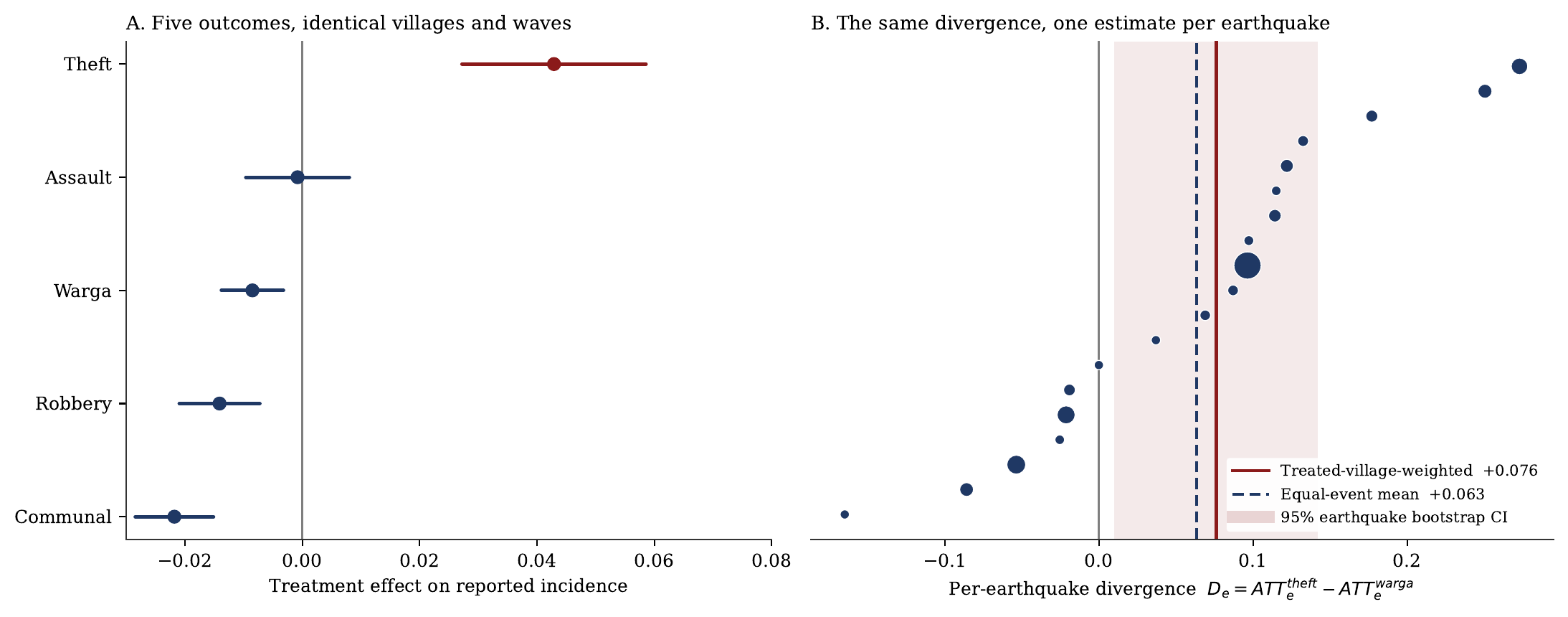
The composition of disorder. Panel A plots the treatment effect on each of five outcomes, estimated on the single common sample of 300,018 village-waves with village and wave fixed effects and 95 percent village-clustered intervals. Communal conflict, robbery, and the civilian-versus-civilian warga series sit below zero, theft sits above it, and assault sits on it. Warga is the subtype whose survey wording is near-stable across all seven waves. Panel B re-estimates the theft-minus-warga divergence separately for each of the 19 usable earthquakes, sorted by magnitude, with marker area proportional to the villages a shock treats. The divergence holds when the earthquake, rather than the village, is the unit of inference.
Draft (PDF) Supplementary material (PDF) This version: 23 September 2026.
Faith after the Shock: Earthquakes, Religious Expenditure, and the Insurance Value of Religion in Indonesia
Does religion function as informal insurance against uninsured risk? The existing evidence rests largely on stated religiosity measured at district level or on aggregate shocks. This project instead observes what households actually pay: religious and ceremonial expenditure in rupiah, drawn from the consumption module used for Indonesia’s official poverty statistics, matched to village-level earthquake exposure on constant 2005 boundaries. The design separates three channels with opposing predictions — the income effect, the club-good or mutual-insurance channel, and the coping channel — using a within-block placebo that isolates the income effect and a continuous exposure measure built from exact event timestamps against the survey’s twelve-month recall window.
Kompetisi dan Efisiensi pada Pengadaan Pemerintah: Bukti Empiris pada Kementerian/Lembaga di Indonesia
Does competition make government procurement cheaper? Using more than 82,000 procurement records from Indonesian line ministries and agencies, we find that each additional bidder lowers the winning bid by about 3.35 percent of the official cost estimate.
2026–2027
PhD Research Grant, ReCIPE Programme
“Crack Beneath and Between: Earthquakes and Communal Conflict in Indonesia’s Seismic Zone.” Centre for Economic Policy Research (CEPR) and the UK Foreign, Commonwealth and Development Office (FCDO).
Shaking Land and Shaking Lives: Essays on the Economic Impacts of Seismic Disasters. Department of Economics, Faculty of Economics and Business, Universitas Indonesia. Expected completion February 2028. Supervisor: M. Halley Yudhistira, Ph.D. Co-supervisor: Jahen F. Rezki, Ph.D.
The dissertation asks how large, plausibly exogenous physical shocks propagate through village-level social and economic life in a setting where formal insurance is thin and local order is largely self-enforced. The chapters share a common empirical infrastructure: a long village panel harmonised onto constant 2005 boundaries, and earthquake exposure constructed from USGS ShakeMap intensity surfaces.
Chapter 1
Earthquakes and Communal Conflict
Village-level evidence from Indonesia, with M. Halley Yudhistira and Jahen F. Rezki. Draft complete, under revision.
Chapter 2
Faith after the Shock
Earthquakes, religious expenditure, and the insurance value of religion. In progress.
I am committed to reproducible empirical work. Replication packages for the dissertation chapters will be posted here as each paper is released: cleaning code, analysis do-files, and the village boundary crosswalk used to harmonise PODES waves onto constant 2005 boundaries.